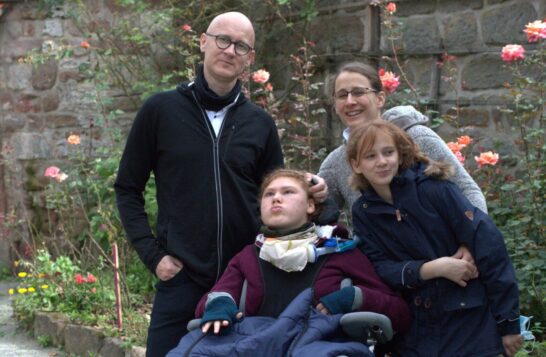
„Finding your own way“ In this interview, pediatrician Nellie from Germany talks about the long journey to her daughter Linn’s diagnosis and her search for a path for her and…
„You can do so much more than you think“ Anna from Germany talks with love about her family’s journey, her son Ole, and her sick daughter Nele. She tells of…
On May 2, 2024, we went live at www.PCH2cure.org – the new knowledge and exchange platform for pontocerebellar hypoplasia type 2. We hope all visitors to this website gain exciting…
In July 2024, 28 PCH children and their families will set off on Cruise4Life, a one-of-a-kind research cruise. Lots of doctors and researchers from the PCH2cure project will spend a…
“He Was Blessed With Many Years” Anke Roesch from Germany takes us on her family’s journey with a PCH2 diagnosis. She talks about the years with her son Sebastian -…
In their 1995 study “The syndrome of autosomal recessive pontocerebellar hypoplasia, microcephaly, and extrapyramidal dyskinesia (pontocerebellar hypoplasia type 2): Compiled data from 10 pedigrees”, Barth et al. collected data from 10 unrelated family pedigrees.
In their 1990 article “The inherited syndrome of microcephaly, dyskinesia and pontocerebellar hypoplasia: a systemic atrophy with early onset”, Barth et al. reported on a neurodegenerative disorder observed in seven children from five related families.
Epilepsy means that the brain or individual areas of the brain are overactive and send out too many signals. This can be detected by means of an electroencephalogram (EEG, recording…
Parents of affected children have reported that their children assume a C-shaped posture over a longer period of time, sometimes for several hours. The children seem to feel highly uncomfortable;…
Feeding difficulties is a broad term. Overall, a feeding situation is considered abnormal if the duration of a meal exceeds 30 minutes, if very frequent meals are necessary (more than…