
Summary
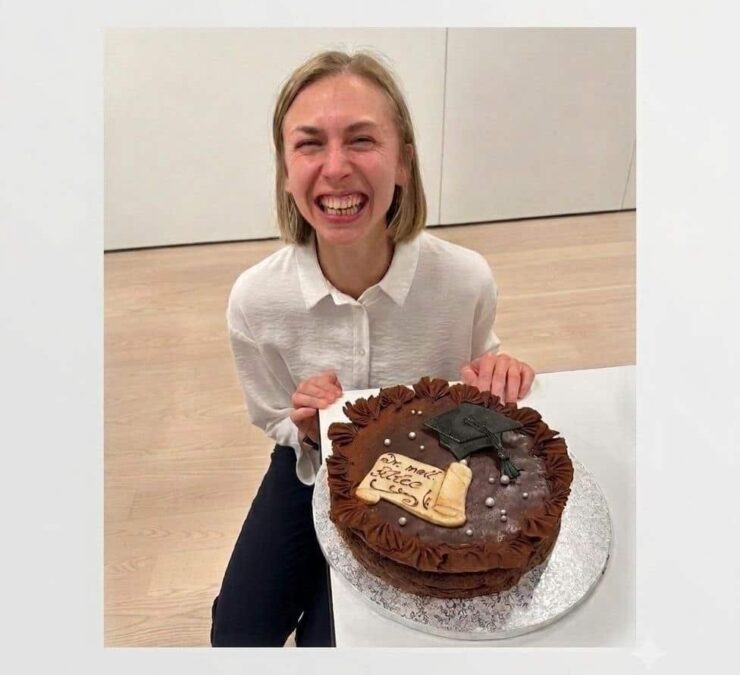
We congratulate Alice Kuhn on her doctoral thesis titled “Gastrointestinal Symptoms, Nutrition, and Thriving in Pontocerebellar Hypoplasia Type 2A.” The thesis addresses survival, diagnosis, and gastrointestinal symptoms in children with PCH2A, as well as their clinical management. It demonstrates that life expectancy has increased, that common gastrointestinal symptoms are frequently managed with medication or tube feeding, and that these symptoms tend to decrease with age. In addition, disease-specific growth charts for children with PCH2A have been developed for the first time, revealing early deviations from the growth patterns of healthy children.
Who Is Alice Kuhn?
Alice Kuhn is a member of the PCH2cure project team and a resident physician in pediatric training at the Department of Neuropediatrics and Muscular Diseases at the University of Freiburg Medical Center.
What Is the Subject of the Doctoral Thesis?
The thesis examines survival and diagnosis in PCH2A, as well as gastrointestinal symptoms, their impact on quality of life, and potential therapeutic approaches. In addition, Alice Kuhn developed PCH2A-specific percentiles (growth charts). The thesis builds on a Natural History Study from 2012 conducted at the University of Tübingen and forms the foundation for an information brochure on PCH2 published in 2025.
What Were the Key Findings?
Children with PCH2A are now reaching a higher age than approximately ten years ago, and genetic diagnosis is being established earlier. Many children experience gastrointestinal symptoms including feeding difficulties, reflux, vomiting, bloating, abdominal pain, and constipation. Treatment primarily involves acid-suppressing medications, often at higher doses, as well as gastric tube feeding (PEG). This form of nutritional support can likely contribute to improved weight development over the long term. Gastrointestinal symptoms place a significant burden on affected children, but tend to decrease with increasing age.
In addition, disease-specific growth charts for children with PCH2A have been developed for the first time. These charts indicate that head circumference, despite the presence of microcephaly, increases slightly with age. Compared to healthy children, body measurements at birth are often within normal ranges, but early deviations emerge over time – most notably in BMI and head circumference.
Conclusion
Alice Kuhn’s doctoral thesis demonstrates that children with PCH2A are living longer than in previous years, and that genetic diagnosis is being established at an increasingly early stage. The numerous gastrointestinal symptoms associated with PCH2 require consistent management, as they represent a substantial burden for affected children and their families. The precise underlying causes of these gastrointestinal complications remain unclear. Further studies are needed to better evaluate the efficacy of available treatments and the clinical utility of the growth charts.
The following publications and informational materials were developed on the basis of Alice Kuhn’s doctoral thesis:
- Information brochure on PCH2: “Natural History of Pontocerebellar Hypoplasia Type 2”
- Publication on the growth charts: “Constructed growth charts for pontocerebellar hypoplasia type 2A” — click here for a summary of the publication and here to read the original article. A video about the publication is also available.
- “Meet the Expert” event on the patient brochure
- “Meet the Expert” event on restlessness in PCH2
- “Meet the Expert” event on nutrition and gastrointestinal problems in PCH2
Read the Complete Study
Find the complete study here:


